Smitesh Bakrania, Ph.D.
Associate Professor of Mechanical Engineering, Rowan University
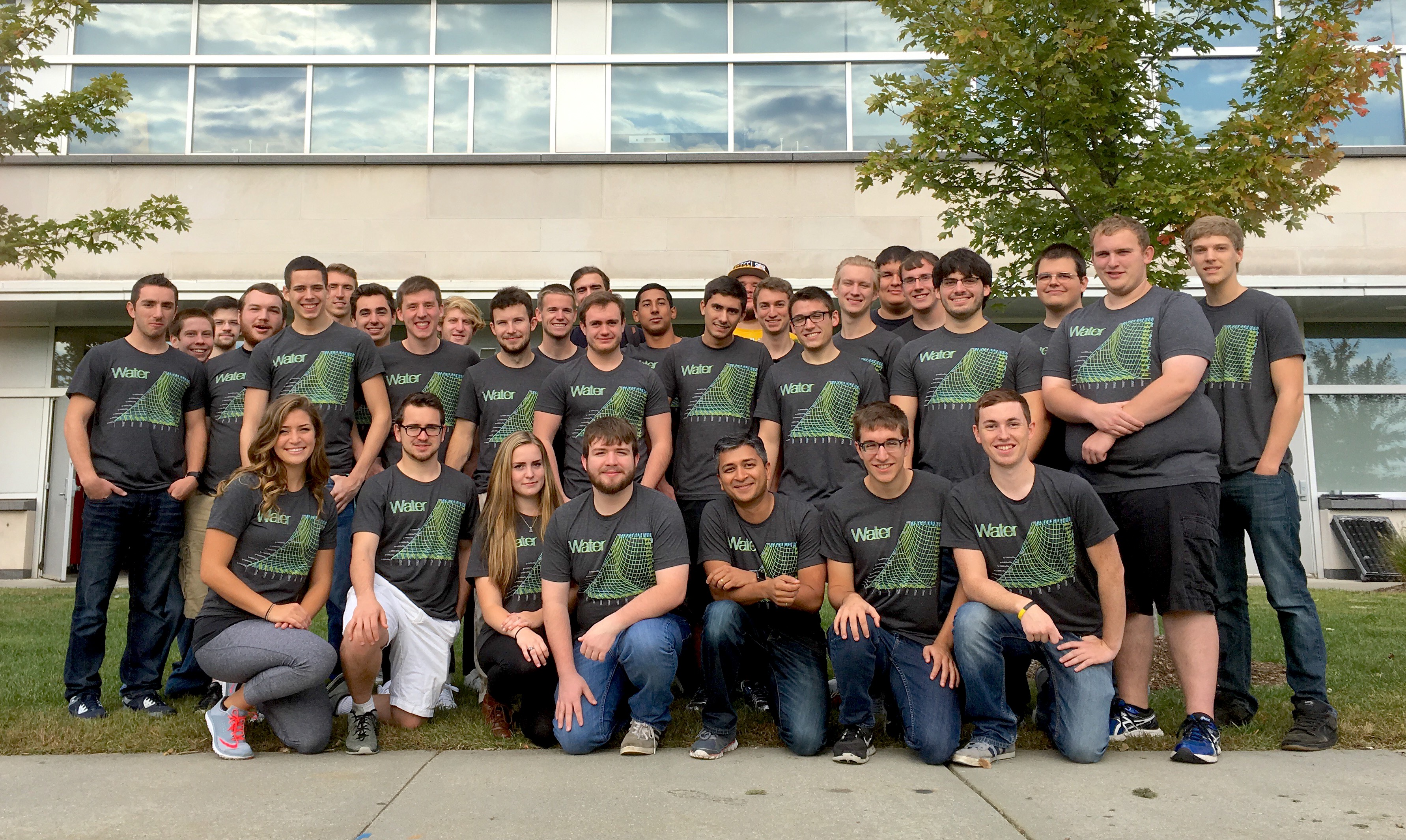
These are my thermal-fluids sciences students sporting the T-s T-shirts. I am third from the right in the front row. Happy being among my tribe.
Why Property Charts?
Needless to say I am a visual learner. When complex information is condensed into a visual form, it simply sticks. I have been teaching Thermal-Fluid Sciences and its compontents since Fall of 2008 at Rowan University's Mechanical Engineering department. I had never used property charts during my undergraduate or graduate years. I was first introduced to property charts by my colleague, Dr. Krishan Bhatia. I was an instant convert. It kick started my journey to develop tools surrounding this neat concept. This project is a culmination of those efforts to make the basics of thermodynamics stick.
Property charts have existed long before. I am not the first to develop them. Unfortunately, they had been relegated to history because they lacked requisite accuracy for thermodynamic computation. This gave rise to steam tables. Steam tables are printed data tables of water properties that can very be accurate, but tedious to use, for computation. Now that accuracy can be easily handled by the simplest of computers, we in academia still feel teaching how to use steam tables is relevant. It is not. Instead, we should be asking, what are the core concepts we need to teach our students? This question drives my efforts. Charts help students visualize thermodynamic properties and that is more fundamental than the ability of looking up properties on a table. Afterall, there is an app for that! It was time to dust off those property charts.
The Journey
My first effort was to develop an iPad app that allowed students to interact with the charts and become familiar with the trends. My studies confirmed the hypothesis that students who interact with the chart can predict property trends better than those who use steam tables. After that, I began to develop videos to support instruction using property charts. Turns out their visual nature lend themselves to visual instruction. This reduced instructional load and provided time for students to deeply connect with thermodynamic fundamentals. I kept adding more videos and embarked on a number of research studies to understand the impact of property charts on student learning.
My drive is fueled by my students. I have seen the outcomes and the difference property charts made in their learning. I have had ample of time to tweak my approaches and optimise them for delivery and retention. I have developed new assessment tools that are better suited for property charts. These tools in turn help my students receive rapid and targetted feedback on their work. Therefore, the benefits of moving away from steam tables have compounded. With this space, I aim to share all the resources to make it easy for instructors to adopt property charts into their thermodynamics courses.
Who am I?
I used to joke with my friends that, "if I fail out of college, I will take up graphic designing." My passion for design still guides my instruction. I enjoy designing learning experiences that optimize knowledge delivery and maximize retention. The T-s T-shirts were a direct result of this passion.
I have been fortunate to experience numerous diverse learning approaches. I grew up in Tanzania and came to the U.S. for an undergraduate degree. I went to Union College, a small liberal arts school, for my B.S. in Mechanical Engineering. For my M.S. and Ph.D., I joined the research power house University of Michigan, working on combustion synthesis of nanoparticles for gas sensing applications. Seeing the full spectrum of learning approaches steared me towards an academic career. I became hyper aware of the fact that how we teach has a tremendous impact on learning. In 2022, I received the prestigious Lindback Distinguished Teaching Award at Rowan University. This was a wonderful reassurance for my chosen path.
I am still learning. My latest interest is how learning can be designed online. In my spare time, I enjoy reading non-fiction books about science, history, and human behavior. I enjoy hiking with my family, or spending time in my garage working on any number of wood projects. Considering I am a cultural nomad, I enjoy going to new places in my travels and appreciating the cultural diversity. In 2018, I was awarded the Fulbright Scholar Award to visit New Zealand. This was a reinforncing cultural experience for me and my family. Now we seek to recreate those novel experiences and enjoy quality time surrounded by nature, books, and interesting people. This was also a driving force for creating a study abroad experience for our engineers resulting in an Engineering in Germany program.